

EZ Mesotherapy Injector Negative Pressure Hydrolifting Device For Skinbooster Injection
-
Detail
EZ-1000 Mesotherapy Injector — Negative Pressure Multi-Needle Injector
The EZ-1000 is a handheld injector for skin booster and mesotherapy treatments. A multi-needle cartridge delivers solution into the upper skin layers while negative pressure holds the skin steady, so the injection depth and the delivered volume are set by the device rather than by hand.
Choose your kit
All four options contain the same device, set up in the same way. They differ only in how much consumable comes with it.
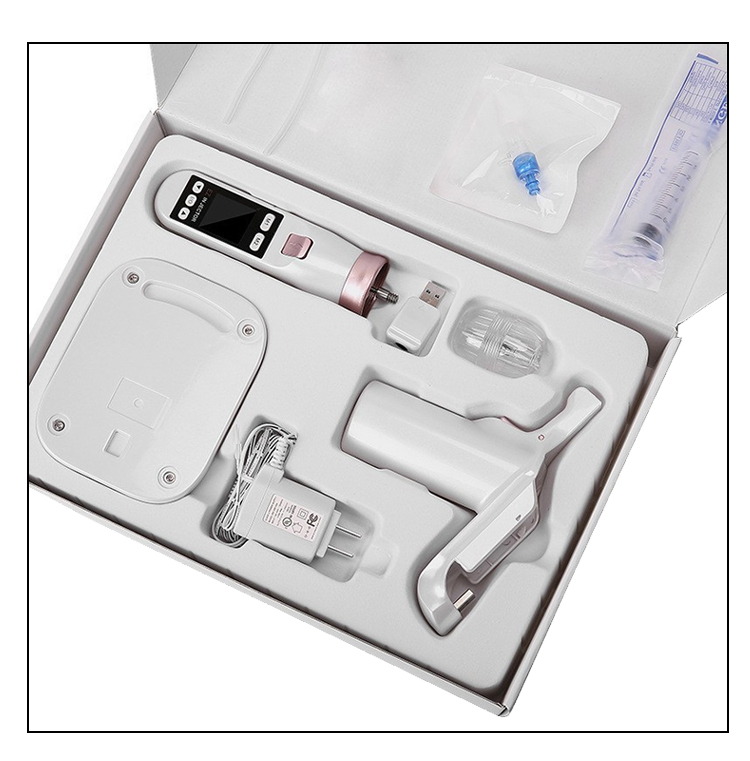
EZ Device Only — the device, with the starter cartridge and syringe shown in the product photographs.
EZ Device + 9-pin pack — the device, plus 10 × EZ-9pin cartridges, 10 × 5 ml syringes, 10 × EZ-Tube and 10 × EZ-Filter.
EZ Device + 5-pin pack — the device, plus 10 × EZ-5pin cartridges, 10 × 5 ml syringes, 10 × EZ-Tube and 10 × EZ-Filter.
Device + Starter Kit — the device, plus 10 × EZ-9pin and 10 × EZ-5pin cartridges, 20 × 5 ml syringes, 20 × EZ-Tube and 20 × EZ-Filter.
Every option includes the host with its injection head, the negative-pressure handle, the charging base and the power adapter.
The consumable counts follow one rule: one cartridge and one syringe per session. The tube and the filter are supplied at the same count, so a course does not run short part-way through.
How it works
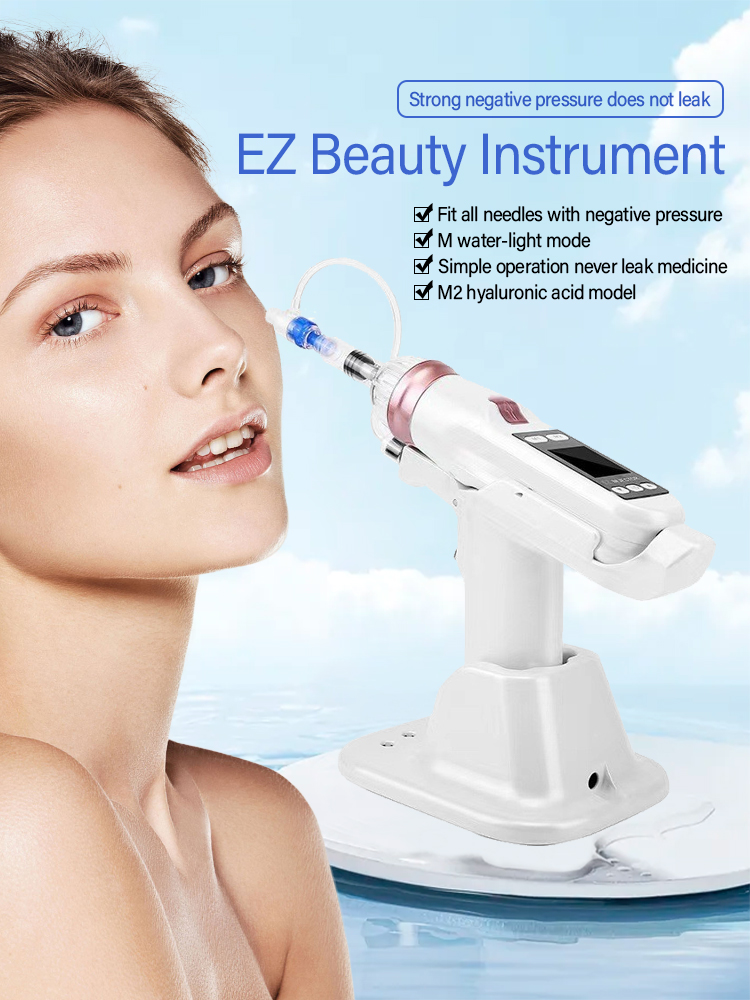
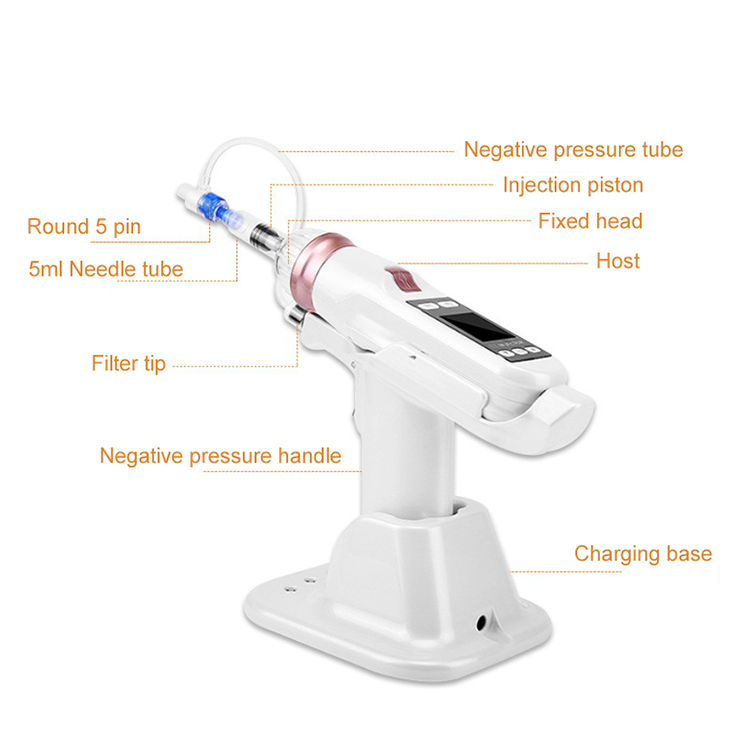
The split negative-pressure handle draws the skin up against the cartridge before the needles enter. This holds the treatment area flat and stable during the shot, and it is what makes the multi-needle arrangement usable on curved areas.
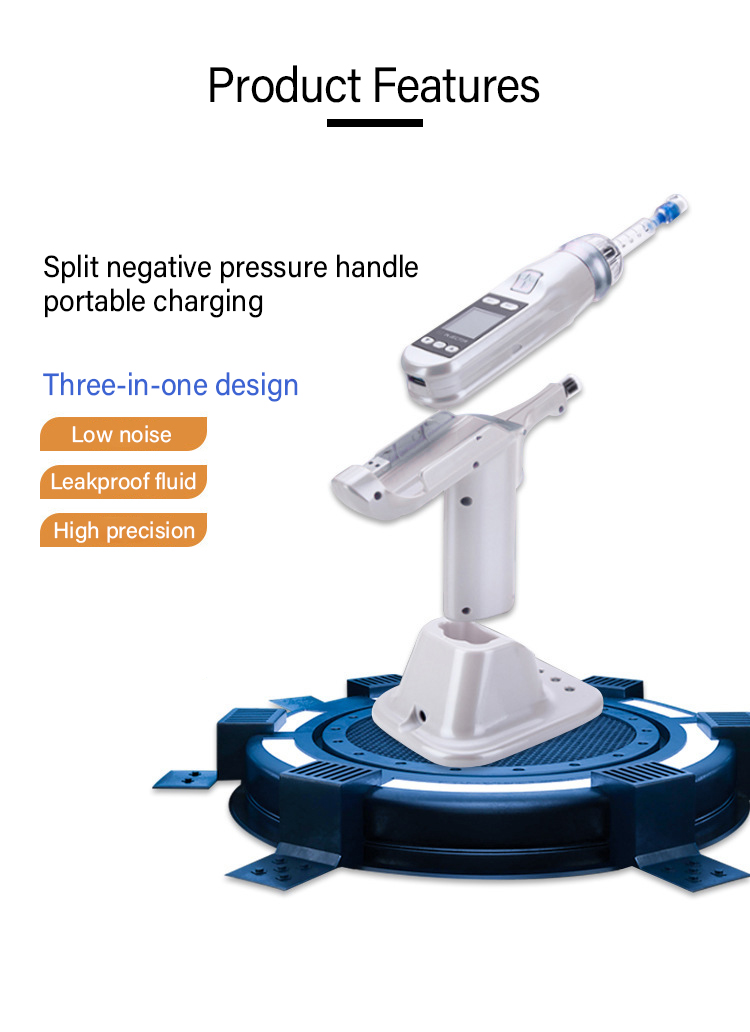
The host carries the control screen and the injection head. The syringe seats into the fixed head at the front and feeds through the inline filter, while the silicone pressure tube carries the suction from the handle. The three parts separate for cleaning, storage and charging.
Unlike a microneedling pen, the needles here carry solution into the skin. Unlike a manual syringe, depth, volume and speed are set on the panel instead of by hand — which is what makes the result repeatable between treatment points and between sessions.
What the device controls
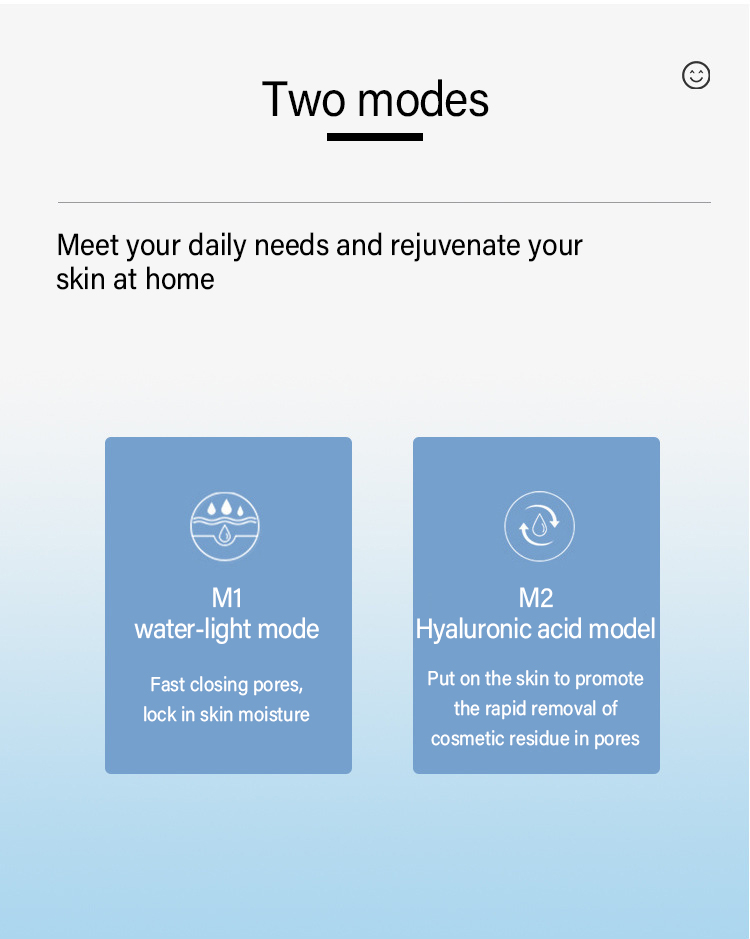
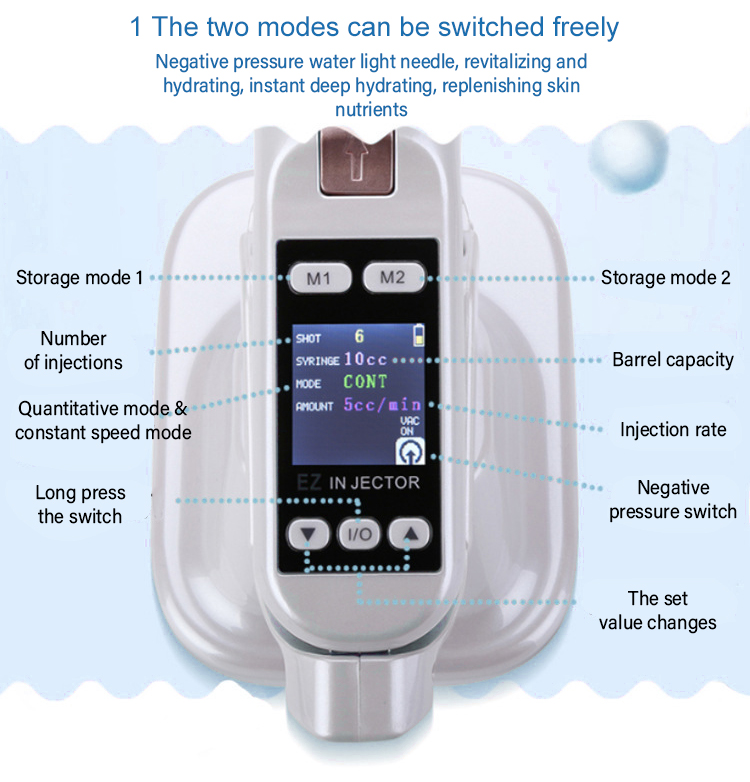
- Shot count and dose, displayed and set on the panel. The 1.5-inch full-colour OLED shows the number of injections, the barrel capacity in cc, the delivery rate in cc per minute, and the active mode. Two settings can be held in memory as M1 and M2 and recalled at the press of a button.
- Two delivery modes. Continuous mode runs the injection while the trigger is held. Dose mode delivers a set amount per trigger press. The mode in use is shown as CONT on the screen.
- Suction, switched at the handle. The negative pressure is engaged by its own switch on the handle, so suction can be released without changing any other setting.
- Depth, adjustable. Injection depth is adjustable, which is what allows one device to cover both the thinner areas of the face and the firmer areas of the neck and body without changing any other setting.
Design and power
The unit separates into three parts — host, negative-pressure handle and charging base — so it can be stored flat and charged without the handle attached.
- Built-in lithium battery, 7.4 V / 580 mAh. No cable during treatment; the charge sits inside the unit.
- Maximum power consumption 4 W. Draw stays low, which is what allows a battery this size to run a session.
- Charger rated 8.4 V DC / 500 mA, input AC 100–240 V. The supplied adapter covers both 110 V and 230 V markets.
- Host 200 g, handle 100 g. Host measures 153 × 30 × 38 mm; the handle measures 170 × 70 × 48 mm. The handle is a separate grip rather than weight carried on the handpiece.
- Materials. Body, handle and charging base are plastic; the syringe fixing head and the inline filter are polycarbonate; the pressure tube is silicone; the syringe is piston type.
Cartridges
Two cartridge types fit the EZ-1000, and this is the question most buyers ask first.
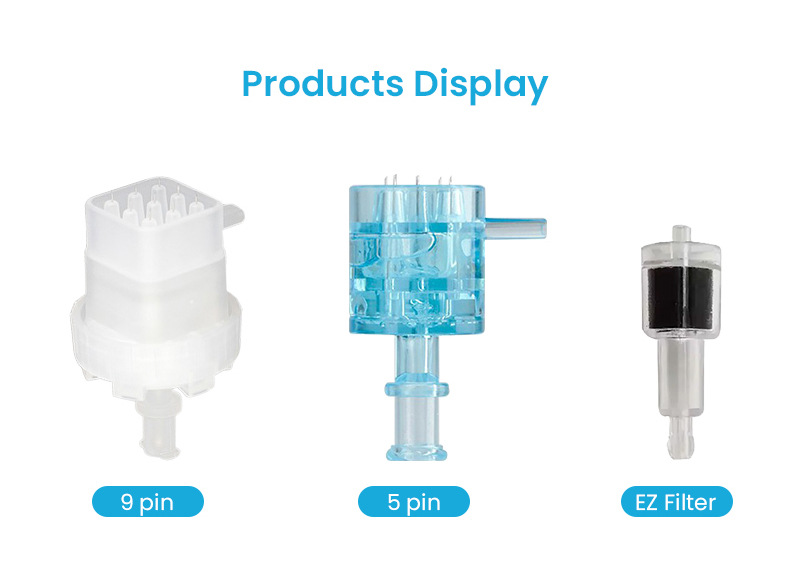
- EZ-9pin cartridge. The general-purpose option, with adjustable depth. Nine points on a fixed pitch cover a broader field per shot, which suits cheeks, forehead, neck, décolletage and body areas.
- EZ-5pin cartridge. Five points in a tighter pattern, for smaller or narrower zones where a wide field would overlap the surrounding area.
Both are sterile and single-use. They cannot be re-sterilised reliably once used, and they are not shared between clients.

What a treatment takes
The device does not work on its own. A session needs a sterile cartridge — the 9-pin for broad areas such as cheeks, neck and body, the 5-pin for tighter zones — and a syringe to load the solution. Both are single-use, so a session uses one of each. The syringe seats into the head at the front of the unit, the EZ-Filter sits in that line, and the silicone EZ-Tube carries the negative pressure from the handle; the filter and the tube are replaced as they wear.
What goes into the syringe matters just as much. The device is built for preparations intended for intradermal injection, and most sessions run a hyaluronic acid skin booster or a mesotherapy cocktail — the Skinbooster collection lists the formulations we stock, and the wider mesotherapy injector range covers the devices and supporting products around them. Needles, syringes, tubes and filters sit together under Needles & Cartridges.
Where a small area is better worked by hand, the same protocol can be run without the device using the Crystal 5 Pin Multi Needle — a 5-point needle at 32G, fixed at a 2.0 mm length.
Before and after treatment
Treatment is an intradermal injection. A topical anaesthetic is applied beforehand and its full contact time should be allowed; on firmer areas that contact time matters more than the stated strength of the cream. Redness settles within roughly 30 to 40 minutes and small needle marks may remain visible for 2 to 3 days. Make-up is best avoided on the treatment day itself.
Treatment intervals depend on the preparation used. A common schedule is three sessions at 2 to 4 week intervals.

Frequently asked questions
Which cartridge should I start with?
Start with the 9-pin cartridge. Its depth is adjustable, so one cartridge covers areas of different thickness, and its wider field makes it the faster option on cheeks, forehead, neck and body areas. Add the 5-pin cartridge when you need a tighter pattern on small or awkward zones.
Which kit should I choose?
Take EZ Device Only if you already hold cartridges and syringes. For a first unit the Starter Kit is the safer purchase: it covers both cartridge types, so finding that a different depth suits your usual area does not mean waiting for a second delivery. A single-type pack is the right choice when you already know which cartridge your work needs.
Which solutions can be used?
Preparations intended for intradermal injection — hyaluronic acid boosters, PDRN and mesotherapy cocktails. Some products sold for microneedling are intended for surface application only; check the intended route of use before filling the syringe.
Do I need a numbing cream?
Yes. Treatment is an intradermal injection and a topical anaesthetic is applied beforehand. Allow the full contact time rather than shortening it on firmer areas.
Why do I lose solution, or get no suction?
In almost every case this traces back to the cartridge, the tube or the filter not being fully seated before the syringe was filled. Re-seat all three, confirm the suction engages on a test surface, and only then load the syringe.
Does it carry CE certification?
Yes, the product carries CE certification. Regulatory requirements vary by market and by product category, so confirm what applies where you operate.
Who should not use it?
It is not suitable during pregnancy or breastfeeding, for anyone with a known allergy to hyaluronic acid, or where there is active infection or broken skin in the treatment area. Anyone with a medical condition or on medication should check with a qualified practitioner first.
-
Customer ReviewsNo comments